Depth to rockhead, the formations encountered and their condition. Without this a pile schedule is an estimate dressed up as a design.
Ground conditions
Three rocks and a clay.
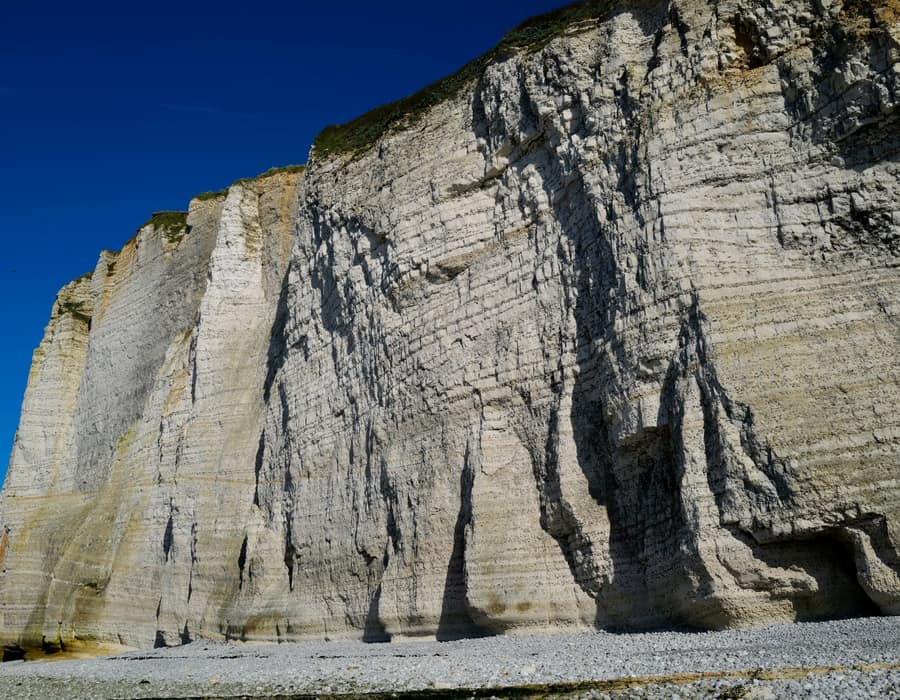
Everything built on these islands sits on the same five formations. Knowing which one you are founding in, and which one sits underneath it, decides the foundation solution.
The succession
Youngest at the top, oldest at the bottom.
The Maltese islands expose a sequence of five sedimentary formations. They do not appear everywhere in full. Blue Clay and Upper Coralline are missing across much of eastern Malta, where Upper Coralline rests directly on Globigerina, and thicknesses vary considerably from one part of the islands to another.
The figures shown are published ranges for the islands as a whole. They are useful for orientation and are no substitute for a ground investigation on your own plot.
Blue Clay is the one that moves
It has low bearing capacity, it swells and shrinks with moisture content, and where it daylights on a slope it is the reason for most of the ground movement recorded on these islands.
Founding in it is rarely the answer. The usual solution is to pile through it into the Globigerina or Lower Coralline beneath, and to keep water away from it during the works. Where an existing building has settled, Blue Clay is the first thing we look for.
Ground investigation
What we need before we can price properly.
Borehole logs
Groundwater
Standing water level and any perched water. This decides whether a retaining wall needs to be secant rather than contiguous.
Neighbouring foundations
What the buildings on your boundaries are founded on, and at what level. This governs the sequence as much as the design does.
Site constraints
Access width, headroom, working hours and the position of services. These determine which plant can physically reach the work.
If you do not have all of this, that is normal and it is not a reason to delay a conversation. We can tell you what is likely from the location and the surrounding geology, then say plainly what we would need confirmed before the price becomes firm.
Send us what you have